BURIED TOGETHER
Partner Elizabeth Blackwell, Alice Stone Blackwell
Queer Places:
Mount Monadnock Apartments, 3 Monadnock St, Dorchester, MA 02125, USA
The Cantabrigia, 1010 Massachusetts Ave, Cambridge, MA 02138, USA
Cliff Cottage, Quitsa Ln, Chilmark, MA 02535, USA
Kilmun Parish Church and Argyll Mausoleum, Kilmun, Argyll and Bute, Scotland
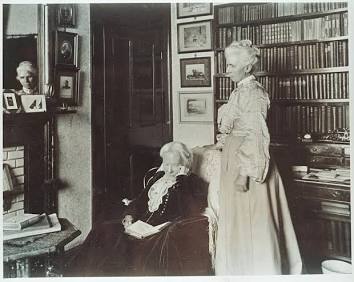 Katharine "Kitty" Barry Blackwell (1848-1936) was an Irish-born woman whose life intersected directly with America’s pioneering medical and women's rights movements.
Adopted as a young orphan in 1854 by Dr. Elizabeth Blackwell—the first woman to receive a medical degree in the United
States—Kitty served as a companion, housekeeper, secretary, and emotional anchor to her famous adoptive mother, as well as the central romantic figure in the life of her
cousin, prominent suffragist Alice Stone Blackwell.
Katharine "Kitty" Barry Blackwell (1848-1936) was an Irish-born woman whose life intersected directly with America’s pioneering medical and women's rights movements.
Adopted as a young orphan in 1854 by Dr. Elizabeth Blackwell—the first woman to receive a medical degree in the United
States—Kitty served as a companion, housekeeper, secretary, and emotional anchor to her famous adoptive mother, as well as the central romantic figure in the life of her
cousin, prominent suffragist Alice Stone Blackwell.
Born in Ireland during the Great Famine, Kitty was orphaned at a young age and placed in the Randalls Island workhouse in New York. In 1854, Dr. Elizabeth Blackwell,
single and looking for companionship, adopted seven-year-old Kitty.
While Dr. Blackwell viewed the adoption partly as an act of social rescue, Kitty quickly became indispensable to her daily life. Over the decades, Kitty managed
household duties, provided administrative support, and cared for Elizabeth as her health declined, residing primarily with her in Hastings, England.
As documented by historian Lillian Faderman in To Believe in Women: What Lesbians Have Done for America, Kitty Barry was
the first and primary love of her cousin Alice Stone Blackwell—daughter of famous suffragist Lucy Stone and Elizabeth’s brother,
Henry Browne Blackwell.
Despite a ten-year age gap and the Atlantic Ocean often separating them (Kitty in England with Elizabeth, and Alice in Massachusetts), their relationship was sustained
through deeply passionate, erotic, and playful correspondence.
In her twenties, Kitty initiated an elaborate roleplay fantasy in letters where she took on the identity of "Captain Robert Kidd" and addressed Alice as her "bride" or
"Dear Betrothed." These letters contained themes of passion, possessiveness, and romantic yearning.
When separated, Alice repeatedly urged Kitty to return to New England, expressing intense affection. In an 1877 letter, Kitty somberly admitted: "If I lost you, life wd
have ceased to be worth anything to me."
Though both women expressed romantic attractions to other women throughout their lives (and Kitty noted her "utter indifference to the male part of creation"), Kitty
remained the emotional center of Alice's life.
Following Dr. Elizabeth Blackwell's death in 1910, Kitty continued living in England for several years. In 1921, fifteen years before her death, Kitty returned
permanently to the United States and made her home with Alice Stone Blackwell.
The two lived together during the culmination of the women's suffrage movement—a victory Alice had fought for as editor of the Woman's Journal (later the Woman
Citizen).
Kitty Barry passed away in 1936 at the age of 88, ending a companionate and romantic partnership that spanned over half a century.
References:
Other references:
- https://en.wikipedia.org/wiki/Kitty_Barry_Blackwell
- https://www.huntington.org/collections/lib-mssblackwell-aspace-23ca6b2e6daa8f34f739c1df89911afb
- https://findingaids.redlands.edu/agents/people/1156
Support this project
This website is a passion project researched, developed, and funded entirely by me. If you find the content valuable and would like to help support the ongoing research and hosting costs, any contribution is deeply appreciated.
Thank you for keeping this independent resource alive!
My books on Amazon: Elisa Rolle's books
BACK TO HOME PAGE
